Updated · View the original (2022)
Outdoor Staging Tips That Sell Texas Homes
In Texas, the backyard is not an afterthought. It is a second living room, and buyers know it. A shaded patio, an outdoor kitchen, a pool that catches the evening light, a Hill Country view off the back deck: these are the features that turn a scroll into a showing and a showing into an offer. So when a listing treats the outdoor space as filler, a few dim snapshots of a bare slab at the end of the gallery, it leaves real money on the table.
The first impression a buyer forms is almost always an exterior. The National Association of REALTORS found that 97% of REALTORS believe curb appeal is important in attracting a buyer, and the same instinct carries to the back of the property. Outdoor staging is how you show a buyer the life the home makes possible, and photography is where that staging either pays off or disappears. This guide keeps the practical outdoor-staging playbook and goes a layer deeper: not just how to set the space, but how to make it photograph like the reason someone buys the house.
Why outdoor space carries extra weight in Texas
Outdoor living has a longer season and a higher ceiling in Texas than in most of the country. A well-appointed patio or pool is usable for the better part of the year, and buyers price that in. That is why staging the exterior is not a cosmetic nicety here. It is you demonstrating usable square footage that never shows up in the interior photos.
Staging works, and the data backs it. The Real Estate Staging Association reports that staged homes spend up to 73% less time on the market than non-staged listings. Outdoor spaces are among the easiest to stage convincingly and the most commonly neglected, which makes them one of the best returns on an afternoon of effort. The goal throughout is the same: give the buyer a scene they can picture themselves in, then photograph it so that feeling survives the jump to a phone screen.
Stage the ground first: clean hardscape and landscaping
Nothing you place on a patio matters if the patio itself reads as tired. The camera is unforgiving with surfaces. Algae streaks on pavers, a chalky gray deck, and cobwebbed corners that the eye forgives in person turn into obvious grime in a wide-angle frame. Clean hardscape is the foundation everything else sits on.
Pressure-wash the deck, patio, and walkways
Pressure-wash the deck, patio, driveway, and front walk, and do it a day or two before the shoot so surfaces are dry and even-toned on camera. Wet or half-dry concrete photographs blotchy. It is worth having a professional handle the wash, because too much pressure will etch soft stone, splinter a wood deck, or strip stain. If a wood deck looks bleached or patchy, a fresh coat of stain restores the rich, uniform color that a lens loves and signals a home that has been maintained. Sweep every loose leaf and twig, clear the cobwebs from railings and light fixtures, and hose down the outdoor furniture. These are small jobs that read as care, and care is exactly what a buyer is trying to infer from a photo.
Tighten the landscaping
Landscaping frames every exterior shot, so it does double duty as staging and as the border of the composition. Mow, edge crisply, trim the hedges into clean shapes, pull weeds from the beds and the cracks in the walkway, and lay fresh mulch. Fresh, dark mulch is one of the highest-impact things you can do on camera: it reads as a deliberate, tidy border and makes greenery pop against it. Trim back any branches that crowd the house or throw hard shadows across the facade. Plant a few flats of seasonal color near the entry and cut in some potted plants, and consider inexpensive window boxes to add life to a flat front elevation. A well-kept yard tells the buyer that the parts of the home they cannot see in a photo have been looked after too.
Furnish the outdoors like a room
The single biggest shift in mindset is to stop treating the patio as leftover concrete and start treating it as a room with no walls. Buyers add furniture in their imagination easily, but they struggle to picture how to use an empty slab. Defining the space for them is what makes a modest patio feel like a destination.
Define the living areas
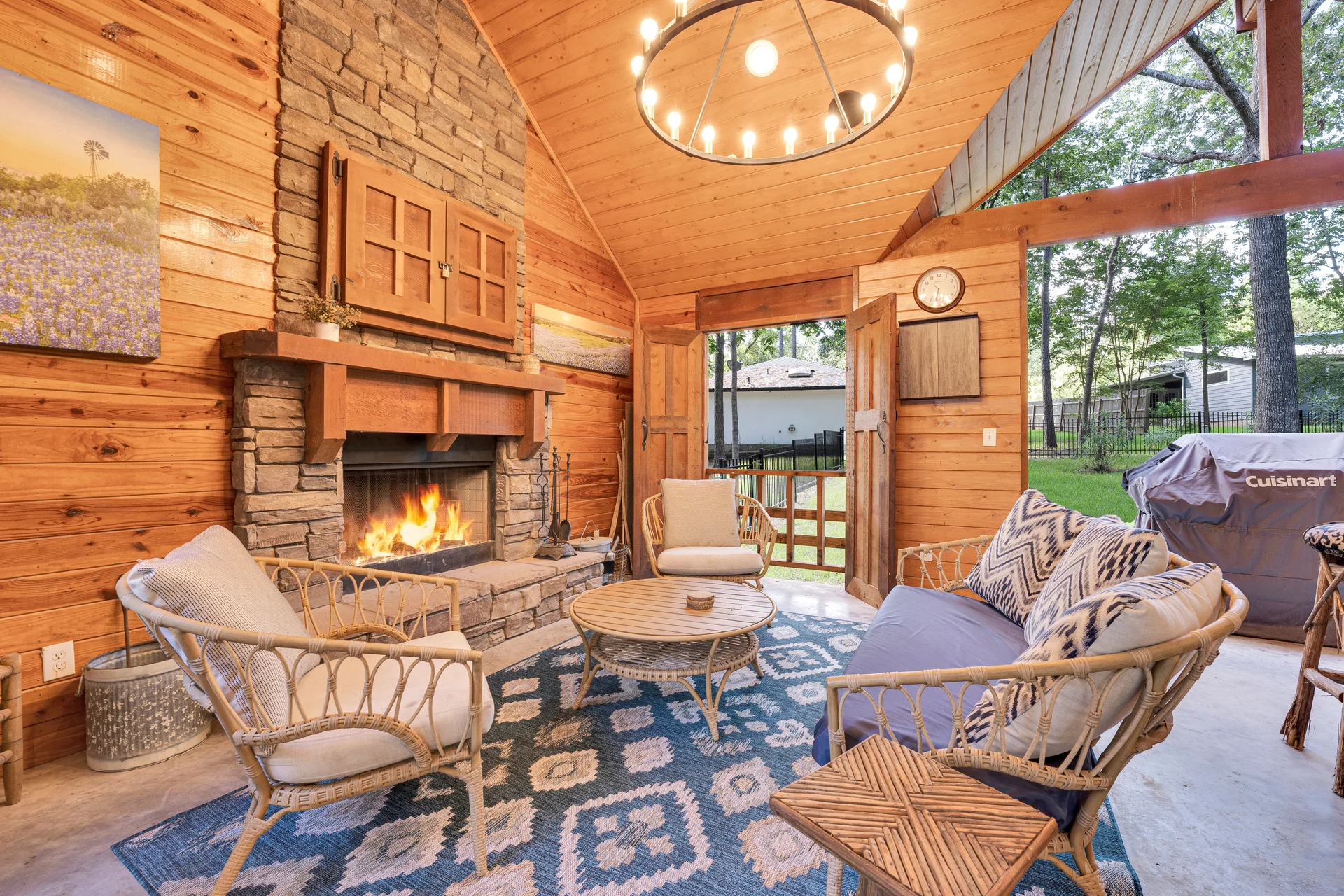
Group furniture into clear zones so the buyer instantly reads the function: a seating area with a sofa and chairs around a coffee table for lounging, a dining set under a pergola or umbrella, a pair of loungers by the pool. A defined layout makes the yard feel larger and more purposeful, not smaller, because it shows the space doing several jobs. An outdoor rug anchors a seating group and gives the camera a clear focal point. If there is a garden bed or a fire pit, stage a small moment around it so every corner of the yard has an obvious use.
Soften the hard surfaces
Exterior walls, fences, and stone floors can feel cold and empty in a photo. Softening them adds the warmth that makes a space look inviting rather than institutional. Lay an outdoor rug, add throw pillows in a coordinated palette, hang breezy outdoor curtains on a pergola, and place a piece or two of weatherproof wall art on a blank exterior wall. Texture is what separates a styled patio from a furniture-store display: it gives the light something to fall across and the photo a sense of comfort.
Layer in color, and keep the palette tight
Color is what makes an outdoor photo feel alive, and potted plants are the cheapest way to add it without landscaping the whole yard. Cluster pots of varying heights near the front door, at the corners of a seating area, and along steps, and use hanging planters to bring color up to eye level on a porch or patio. Choose a restrained palette, two or three colors that complement the home, rather than a scattershot of every bloom at the nursery. On camera, a tight, intentional palette reads as design. A chaotic one reads as clutter.
Stage for the season, and shoot in the right light
Match the styling to the time of year the home is actually on the market. Bright, summery cushions and fresh greenery in the warm months, richer tones and evergreen accents in winter so a bare yard still has a point of color. The staging should match the season a buyer sees when they pull up, because photos that are visibly off-season quietly signal that a listing has been sitting.
Then there is the light, which matters more outdoors than anywhere else in the shoot. Harsh midday sun blows out a pool deck, buries the patio in hard shadow, and flattens a facade. The best exterior photography happens in the softer window near golden hour, when low, warm light rakes across the hardscape and gives the landscaping depth. A skilled photographer plans the visit around the sun: a facade that faces east photographs best in the morning, a west-facing backyard glows in the late afternoon. That timing is not fussiness. It is the difference between a patio that looks like a place you want to be and one that looks like a slab in the glare.
Light it for the evening: exterior lighting and twilight
Buyers are curious about how a home feels after dark, and outdoor living in Texas is often an evening activity. A property that goes pitch black in every photo leaves that question unanswered. Simple exterior lighting fills the gap: path lights along the walk, lanterns around the patio, string lights over a seating area or pergola. Warm, low lighting makes a backyard feel like a retreat, and it gives the camera something to work with once the sun is down.
The payoff of all that lighting is the twilight shot. A twilight photograph taken in the brief window when the sky turns deep blue and the home's lights glow warm is consistently one of the most-clicked images in a gallery, and it is where a staged outdoor space looks its absolute best. Pool lights come alive, the patio reads as an intimate room, and the whole property takes on the mood of an evening a buyer wants to have. For a home that leans on its outdoor living, leading the listing with a twilight exterior is one of the highest-return decisions an agent can make. Getting it right is a matter of timing and technique: the good light lasts only a few minutes, so the furniture, the lamps, and the pool need to be set before the sky turns.
Show the setting: drone and aerial
Ground-level photos can only say so much about outdoor space. They cannot show how the pool, patio, and yard relate to each other, how private the lot is, or that the back deck opens onto a Hill Country hillside or a stretch of lakeshore. That context is often the whole reason a buyer chooses one home over another, and it is exactly what an overhead frame delivers.
Aerial imagery has moved from a luxury add-on to an expectation: the National Association of REALTORS reports that 52% of REALTORS use drone photography or video. A single aerial photograph can convey lot size, mature trees, the layout of the outdoor amenities, and the setting beyond the fence line in a way no ground shot can. For lakeside and Hill Country listings across the Austin-to-San Antonio corridor, the drone is often what sells the location. One practical note: flying commercially requires an FAA Part 107 certificate, so this is a piece of the shoot that has to be handled by a licensed operator rather than a hobby drone.
When the yard is bare: honest virtual staging
Not every listing has the time, budget, or weather to physically stage an outdoor space. Rental furniture, delivery, and setup take days and real money, and a vacant patio photographs as an afterthought. Virtual staging is the practical answer: it furnishes an empty patio, adds a dining set or a lounge grouping, and shows the buyer how the space is meant to be used, without a staging crew. It is faster to deploy, cheaper than physical staging, and flexible enough to present the same space more than one way.
The one rule that matters: keep it honest. Adding furniture, greenery, or warm evening light to show a space at its potential is fair game, and a day-to-dusk conversion that reflects how the home genuinely looks is a legitimate technique. Inventing features that are not there, a pool, an outdoor kitchen, a view, is not, and disclosing digitally staged images is now both an ethical baseline and, in a growing number of states, a legal one. Virtual staging done transparently, with a clear note that the images are digitally furnished, stays firmly on the right side of that line and still does its job: helping the buyer see the life the yard makes possible.
The through-line: stage it, then shoot it right
Every tip here points the same direction. Clean the hardscape, tidy the landscaping, furnish the space like a room, layer in color and light, and then capture it in the light that makes it look like the reason to buy the house. Outdoor living is one of the strongest cards a Texas listing can play, but only if the photos let a buyer feel it before they ever visit.
If your recent galleries treat the backyard as an afterthought, that is the easiest fix in the listing. See how we shoot Texas real estate, indoors and out, and hold the standard across every market we cover.