Updated · View the original (2022)
The Real Benefits of Professional Real Estate Photography
A buyer decides whether to look closer at a home in about a second, and that decision is made almost entirely on the first photograph. Before the price registers, before the address or the square footage, the image either earns the click or loses it. That is why photography is not a line item to trim on a listing. It is the front door to everything else.
The return is measurable. Redfin found that homes between $200,000 and $1 million shot with a professional camera sold for $3,400 to $11,200 more relative to list price than comparable homes with amateur photos. Against a Texas commission, the cost of a professional shoot is a rounding error that moves the number that actually matters. Anyone can point a phone at a living room, so the real question is what a professional does that a phone cannot. Here is what you are actually paying for.
Equipment built for the hardest subject in photography
Interiors are genuinely difficult to photograph well. Rooms are tight, windows blow out to white while the walls fall into shadow, and straight lines bend the moment a lens tilts even slightly. A professional shoots this with gear chosen for exactly those problems: a full-frame camera, a wide lens corrected to keep verticals true, a sturdy tripod for sharpness in low light, and off-camera flash to lift the shadows a phone cannot reach.
Buying that kit yourself runs well into the thousands, and the gear is the easy part. Knowing how to use it in a north-facing bedroom at four in the afternoon is the part that takes years. When you hire a photographer, you are renting both the equipment and the judgment that drives it, for a fraction of what either is worth alone.
Windows and interiors that are both correctly exposed
Look at an amateur listing photo and you will usually see one of two failures: a bright window over a dim room, or a well-lit room with the window blown to a white rectangle. Your eyes never see it that way in person, so the photo feels wrong even when the viewer cannot name why.
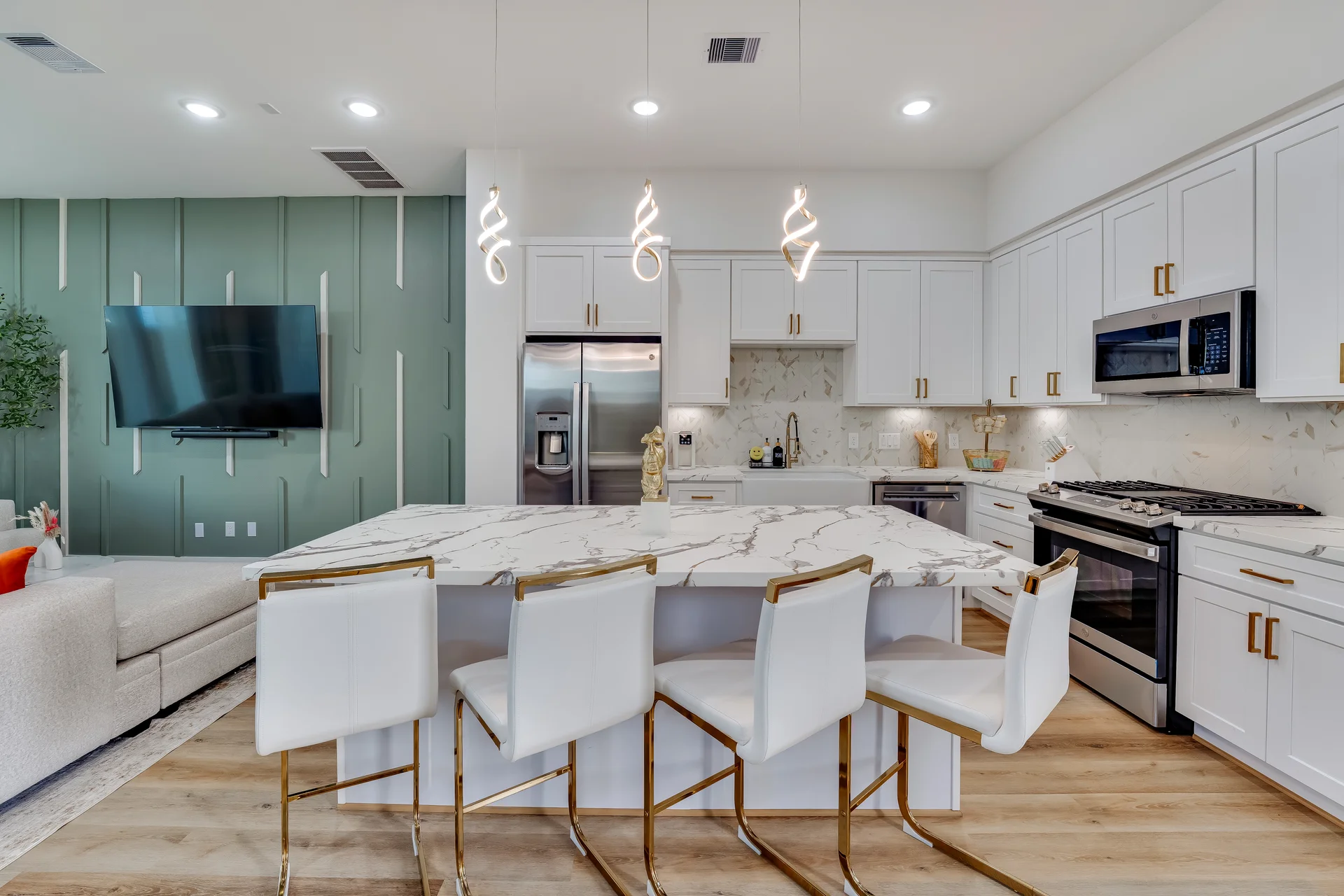
Professionals solve this with technique, not luck. Blending several bracketed exposures, or adding flash to balance the room against the daylight, holds detail in the shadows while keeping the view out the window intact. The Texas sky reads blue through the glass and the room reads warm. That balance is the single clearest difference between a snapshot and a photograph that sells, and it is nearly impossible to fake after the fact.
Composition that shows space honestly
Every room has one or two positions that show it best: a corner that reveals the flow, a height that keeps the counters level, a framing that leads the eye toward the light. Finding those positions quickly, across a dozen rooms, without distorting the space, is a skill built over thousands of shoots.
It is also where amateurs most often overreach. Shooting too wide to make a room look bigger produces a funhouse effect that buyers now recognize and distrust, and that distrust follows them into the showing. A professional shows a room as generously as possible while keeping it honest, so the buyer who walks in feels the home lived up to its photos. Trust survives the visit, and trust is what closes.
Editing that finishes the image without faking it
Capture is only half the job. The rest happens in editing: correcting white balance so a lamp-lit room does not turn orange, straightening verticals, cleaning sensor dust, and matching the light across a full set so the gallery feels like one coherent walk through the home. Done well, editing is invisible. Done badly, with heavy filters and cranked saturation, it screams amateur and can actively mislead.
Professionals hold a firm line here, and the law now backs it up. Enhancing light and color is craft. Erasing a neighbor's roofline or using AI to add a feature that does not exist is misrepresentation, and disclosure rules are tightening: a growing number of states now require digitally altered listing photos to be disclosed and marked, with California's AB 723 among the most prominent examples. A professional knows exactly where that line sits and stays on the right side of it, which protects the agent as much as the buyer.
Experience that turns a good shoot into a consistent one
The value of experience is consistency. A professional who has photographed thousands of homes walks into an unfamiliar house and knows, quickly, where the light is going, which rooms will fight back, and how to sequence the shoot before losing the afternoon sun. That fluency is why a pro's gallery looks strong on every listing, not just the easy ones, and consistency is exactly what a seller is trusting an agent to deliver.
Staging judgment that photographs well
Great real estate photography is not only about angles and light. It is about presenting a home so a buyer can imagine living there. The Real Estate Staging Association reports that staged homes spend up to 73% less time on the market, and a photographer who understands staging knows what the camera rewards: a decluttered surface, a chair turned toward the window, negative space that lets a room breathe. When a home is vacant, virtual staging can furnish empty rooms convincingly and, disclosed honestly, helps buyers picture the space without misleading them.
A complete media set, not just stills
Today's buyers, and especially the relocation buyers so common across Texas, expect to explore a home before they ever visit. Stills alone no longer do that. According to the National Association of REALTORS, 52% of agents now use drone imagery, roughly 70% of home shoppers use video to tour a home's interior, and Matterport reports listings with a 3D tour sold up to 31% faster and for up to 9% more.
A professional shoot is the moment to capture all of it in one visit, consistently lit and color-matched: aerial photography of the lot and neighborhood, a 3D walkthrough for out-of-town buyers, and video that gives the home motion and story. Assembling that from three different sources later never matches the coherence of one professional visit. One practical note: flying a drone commercially requires an FAA Part 107 certificate, so that piece genuinely has to be handled by a licensed operator.
A genuine return, not just an expense
The honest case for professional photography is not that it is cheap. It is that it pays for itself. Better images pull more clicks, more clicks bring more showings, and more showings create the competition that protects your price, which is exactly what the Redfin figures reflect. Set against the commission on a Texas home sale, the shoot is a small, high-leverage investment in the number that matters most.
There is a reputation dividend for agents, too. Your listing gallery is a portfolio every future seller studies before choosing who to hire. Consistently strong photography is one of the clearest signals that you take the work, and their home, seriously.
See the difference on your next listing
If your recent galleries feel flat next to the best listings in your market, the fix is rarely the house. Explore how we shoot Texas real estate, and the standard we hold across every market we cover.