Updated · View the original (2021)
10 Reasons to Hire a Professional Houston Real Estate Photographer
Presentation decides which Houston listings sell. Buyers here have plenty of homes to choose from and about two seconds to spare for each one, so a rushed phone gallery is the easiest listing in the search to skip. When inventory is tight, weak photos can still sell a home. The rest of the time, presentation is the difference between a listing that gets toured and one that gets scrolled past, and the numbers back that up: Redfin found that homes between $200,000 and $1 million shot with a professional camera sold for $3,400 to $11,200 more relative to list than comparable homes with amateur photos.
The home search now begins on a screen. In the National Association of REALTORS 2025 Profile of Home Buyers and Sellers, 52% of buyers found the home they purchased online, and nearly every search starts there before a single showing is booked. That first screen is a grid of thumbnails, and your photography is the whole pitch. Here are ten concrete reasons Houston sellers and agents hire a professional to shoot a listing, and what each one is really buying you.
1. It gives you your time back
Selling a home in Houston is already a second job: coordinating repairs, staging, showings, paperwork, and a move. Photographing it well is not a task you slot in between the others. A proper shoot is a workflow, not a walk-through with a phone. Rooms have to be lit and composed, then several bracketed exposures per frame get blended, verticals get straightened, color gets corrected, and the set gets sequenced so the gallery tells a story from the street to the backyard. That is hours of skilled editing on top of the capture itself.
Hand that to a professional and you get back the evening you would have spent fighting your phone's camera and a photo app, and you get a delivered, portal-ready set instead of a folder of dim snapshots. On most Houston listings the shoot is scheduled, captured, and returned edited faster than a seller could learn to fix a single blown-out window.
2. It captures what a phone camera physically cannot
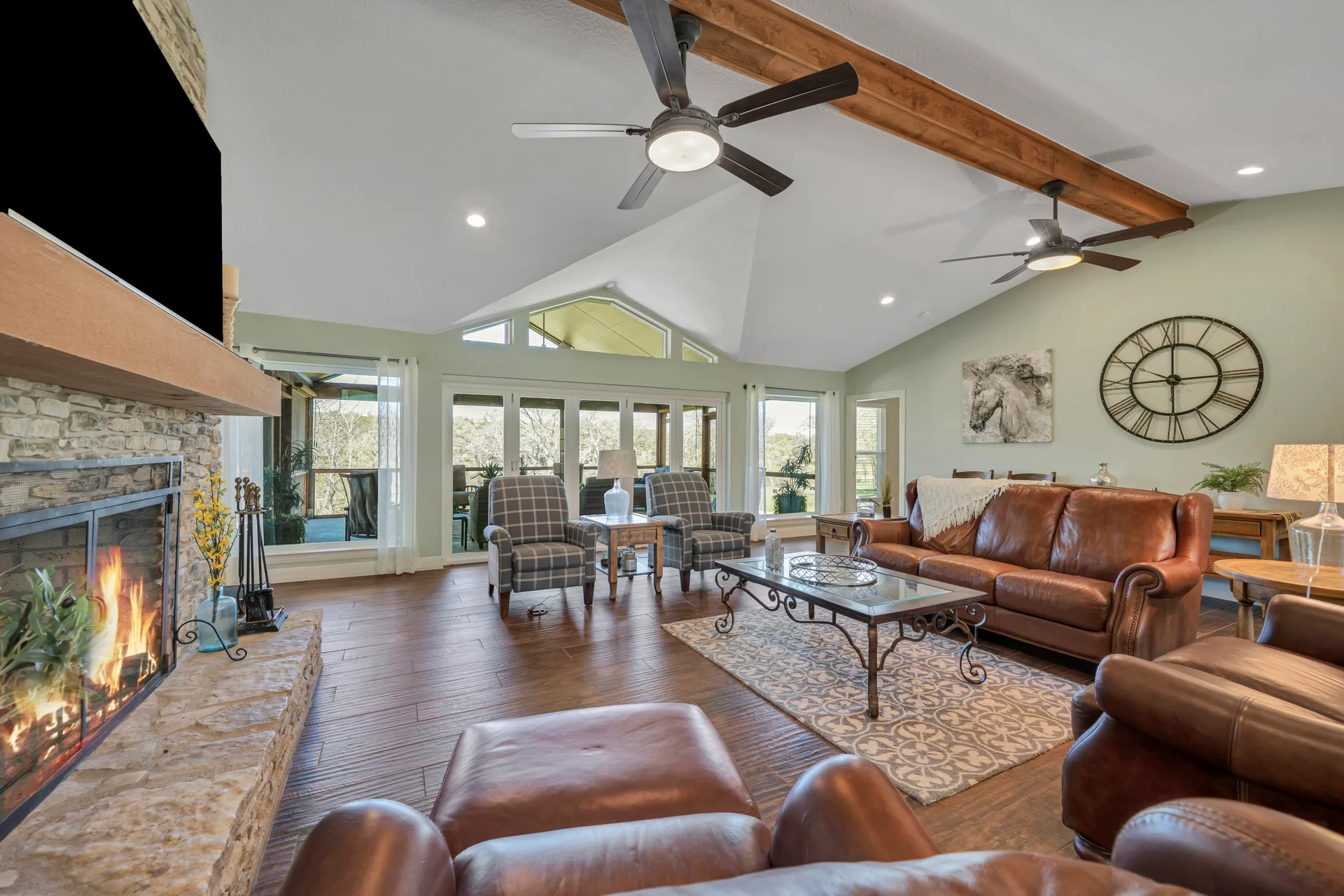
Interiors are one of the hardest subjects in photography, because the human eye sees a bright window and a well-lit room at the same time and a camera cannot. Point a phone at a Houston living room with the afternoon sun coming through the glass and you get one of two failures: a glowing white rectangle where the window should be, or a properly exposed window over a room gone dark and gloomy. A professional solves this by blending multiple exposures or adding flash to lift the room until it balances the light outside, so the sky reads blue through the window and the room reads warm.
The gear does the rest. A full-frame camera on a tripod gathers light cleanly in the dim primary suite where a phone goes grainy. A quality wide-angle lens shows a room generously without the fisheye bulge that makes buyers distrust the whole listing, and lens-correction profiles keep the walls straight. Sharpness, dynamic range, and honest color are not app filters; they are the baseline of professional real estate photography, and buyers register the difference instantly even when they cannot name it.
3. It wins the first impression, which is the only one you get
A buyer's first decision about your home is made on the thumbnail, before they read the price, the square footage, or the school ratings. If the lead image does not stop the scroll, nothing else on the listing gets seen. That single frame has to be your strongest: a clean, well-lit exterior, or a hero twilight shot for a home that shows well at dusk, when the sky glows and the windows read golden. Twilight exteriors are among the most clicked lead images in real estate precisely because they stand out in a grid of flat midday photos.
Humans are visual and fast. We sort images we like from images we dislike in an instant, and a dark, cramped, crooked photo tells a buyer the house is dark, cramped, and neglected before they know anything else about it. A professional makes sure the first thing a Houston buyer feels is that this home is bright, spacious, and worth a closer look.
4. It puts you ahead of the listing next door
Your Houston listing is not competing in a vacuum. It is sitting in a search result beside a dozen similar homes, and buyers triage that grid ruthlessly. Plenty of sellers still cut the corner and post their own photos, and that is your opening: the professionally shot listing consistently pulls more clicks, more saves, and more showing requests than the amateur one beside it at the same price.
More traffic at the top of the funnel is the whole game. Every extra buyer who opens your listing instead of scrolling past is another chance at a showing, and every showing is another chance at an offer. Good photography does not just make the home look better; it wins the click that everything else depends on.
5. It fuels the marketing that actually reaches buyers
Strong images are not only for the MLS. They are the raw material for every place a listing gets promoted: agent social feeds, paid ads, email blasts, and the branded pieces that circulate before an open house. In NAR's technology research, 39% of REALTORS say social media delivers their highest-quality leads, ahead of any other tool, and social platforms are unforgiving of weak imagery. A crisp, well-lit set travels; a dim phone photo dies in the feed.
This is where a coordinated marketing kit earns its place, packaging the stills, video, and floor plan a listing needs to show up everywhere a Houston buyer is looking. The photography is the asset; the reach is what it buys you.
6. It lifts the perceived value of the home
Buyers assign value to what they see, and they see the photos first. A home presented in bright, well-composed images reads as better cared for and more valuable than the identical home shown in flat, cluttered snapshots, and that perception follows the buyer into the showing and the offer. This is not a soft claim. The Redfin analysis above tied professional photography to thousands of dollars in additional sale price relative to list, a gap that dwarfs the cost of the shoot on any Houston listing in that price band.
The point is not to make the home look like a different home. It is to make sure the real value of the property is not quietly discounted by presentation that makes it look like less than it is.
7. It shortens time on market
Homes in the Houston area are taking longer to sell than they did at the peak of the seller's market, which makes anything that compresses that timeline worth real money in carrying costs. Two proven levers run straight through the shoot. Staging is the first: the Real Estate Staging Association reports that staged homes spend up to 73% less time on the market than non-staged listings, and photography is where staging either pays off or disappears. When a home is vacant, virtual staging can furnish empty rooms convincingly, as long as it is clearly disclosed.
The second lever is immersive media. Matterport's analysis of MLS transactions found listings with a 3D tour sold up to 31% faster and for up to 9% more. A 3D walkthrough lets a serious buyer pre-qualify the home from their couch and arrive ready to move, which is exactly what shortens the road to a signed contract.
8. It generates more showings and more offers
Every offer starts as a showing, and showings come from buyers who could picture the home before they drove over. That means giving them more than tight close-ups of cabinet hardware. Buyers want to understand space and flow, and the single most underused tool for that is the floor plan: Zillow found that 81% of buyers are more likely to tour a home when the listing includes one. A simple floor plan answers the question photos cannot: how the rooms connect.
Today's buyers, and especially the relocation and out-of-state buyers so common in Houston, expect to explore before they visit. Google and NAR's research found that 70% of home shoppers use video to tour a home's interior, and NAR reports that 52% of agents now use drone imagery. Pairing strong stills with video and aerial photography that shows the lot and the neighborhood gives more buyers a reason to book. One note on the drone: flying commercially requires an FAA Part 107 certificate, so that piece genuinely has to be handled by a licensed operator.
9. It reduces the pressure to cut the price
A listing that opens slow gets fixed the expensive way, with a price reduction. And a price cut does more than lower the number; it signals to the market that something is wrong, invites lowball offers, and resets the days-on-market clock in buyers' eyes. Most of the time the house was never the problem. The presentation was, and the listing simply never got the traffic that produces offers.
Getting the photography right before the home goes live is the cheaper path by a wide margin. Strong first-week performance, when a listing draws the most attention it will ever get, is what keeps a seller off the reduction treadmill. It is far easier to earn the right price with the right images than to chase it down with cuts after the momentum is gone.
10. It creates the emotional pull that closes buyers
People justify a home purchase with logic, but they commit to it emotionally, and photography is where that connection is made. Empty, sterile rooms tell a buyer what is physically there. A thoughtfully composed, well-lit set tells them what their life could feel like in the space: coffee at that kitchen island, evenings on that covered patio, the Houston light coming through those windows. That feeling is what turns a saved listing into a showing and a showing into an offer.
The craft is honesty. Enhancing light, color, and composition is ordinary and expected. Inventing features that are not there is not, and the rules have caught up: NAR expects materially altered listing images to be disclosed, and a growing number of states now require agents to disclose digitally altered photos, keep the original, and mark the altered version clearly, with California's AB 723 among the most prominent examples. Texas agents should read the direction of travel as settled: enhancement is fine, alteration must be disclosed, and honestly furnished virtual staging stays firmly on the right side of that line. A professional knows exactly where it runs.
The bottom line for a Houston listing
Every reason on this list points the same way. In a market with more inventory and more patient buyers, the listings that win are the ones that present the home honestly and at its best across stills, aerials, video, 3D, and a floor plan, all captured in one coordinated visit so the look stays consistent and the gallery stays complete. That is what a professional brings that a phone cannot, and on a home priced in the hundreds of thousands, the return on it is not close.
If your recent galleries feel a step behind the strongest listings in your market, the fix is rarely the house. See how we shoot real estate across Houston and the standard we hold on every listing.